The narrator enters the school to find Jake
I'm Thinking of Ending ThingsThe narrator enters the Rural High School to find Jake after he leaves her alone in their car, and the decision shifts the scene from a cold, reluctant wait to a search inside a dark building. The entry is driven by practical isolation, mounting fear, and uncertainty about what Jake has gone to confront; it also gives physical form to the narrator’s conviction that their relationship is already ending.
Waiting Outside the School
A series of loud bangs comes from inside the school, each intensifying the narrator’s alarm. The fourth is the loudest, and she concludes that the sound is definitely coming from within the building. Jake has been gone long enough for her to wonder whether his confrontation with the school custodian means an argument, a fight, or something worse. She calls his name without receiving an answer. His last instruction was to remain in the car, but that instruction increasingly conflicts with the immediate fact that he has not returned.
The setting leaves her few alternatives. The car is cold, the night is dark, and the narrator’s phone is dead, so she cannot call for help or arrange another way out. There is nowhere nearby to walk, and she expects the temperature to keep dropping. She understands that waiting is not sustainable, even as she resents being left behind. The practical need to find Jake becomes the reason she acts, while her uncertainty about what is happening inside makes the decision feel dangerous rather than reassuring.
Her thoughts connect the immediate crisis to the trip that brought them there. She wishes she were at home reading or sleeping and regrets agreeing to visit Jake’s parents and the house where he grew up. She had been curious, but now regards that choice as unfair to herself: she believes the relationship was never going to last and thinks she should have ended it earlier. The scene therefore places a private decision about separation beside a literal threshold she has not yet crossed. Her wish for the situation to end is both relational and immediate, but it does not remove the need to act.
Leaving the Car
Before getting out, the narrator reaches behind the driver’s seat for Jake’s wool hat, which she remembers him placing there when they first entered the car. It fits better than she expected. This small preparation registers how exposed she is to the cold and how dependent the search is on what Jake left behind. She opens the door, steps out, and shuts it without slamming it; even in urgency, her movements remain controlled and quiet.
She approaches the school slowly, shivering as her feet crunch over the snow. Her breath appears and then vanishes in the air, while wind drives the falling snow at an angle. She looks up at a sky unexpectedly full of stars. The brief attention to the stars does not resolve the danger or comfort her; it interrupts the dark, close pursuit of Jake with a wider view of the night before the search resumes. At a window about thirty feet from the car, she shields her eyes and peers through floor-to-ceiling blinds. Bookshelves make the room look like a library or office, but the blinds prevent her from seeing anyone. She knocks on the cold glass, then knocks harder, and still gets no answer.
Following Jake’s Route
The narrator finds a green garbage can and opens it. It is half full of beige salt, confirming something Jake had told her. She replaces the lid, but its dented, warped shape prevents it from fitting properly. The detail offers no way into the school and no sign of Jake; instead, the failed lid marks another small obstruction in a search already shaped by limited options. She decides she cannot return to sit in the car and heads toward the side of the school where Jake went, following his steps as they become difficult to make out.
She passes two green Dumpsters, which she recognizes as the ones where Jake disposed of the cups, and sees darkness and open fields beyond them. A door lies just past the Dumpsters, and she concludes that Jake must be inside. Behind the school the wind is worse, funneled along the building; she holds her jacket together and continues toward the windows beside the door. The route is not a confident pursuit. She has begged Jake to stay with her and thinks they never needed to come there, while the snow, failing visibility, and distance from the car steadily narrow her sense of choice.
Crossing the Threshold
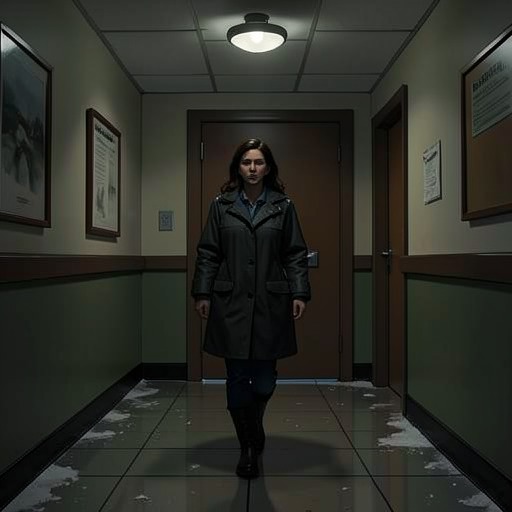
Before entering, the narrator sees someone on the hallway floor. The figure seems to move its head, then crawls or slithers down the hall. She cannot establish who it is or what the movement means, but the sight changes the search from a question of where Jake has gone into an immediate need to get inside and leave together. She runs to the side door, pulls its handle, and finds it open. After stepping through, she is faced with a tiled floor and a very dim corridor that stretches ahead. She calls for Jake, but the passage does not confirm that he is there.
Inside, the narrator notices the antiseptic, chemical smell of cleaning products, which reminds her of a dull headache she had temporarily forgotten. The entry thus brings her closer to the person she is seeking without delivering certainty or safety. Its suspense depends on the gap between what she can observe and what she can know: Jake is absent, the figure’s identity is unclear, and the open door offers access without an explanation. The decision to go in is at once a practical response to being stranded and a point of no return in the scene’s movement from waiting outside to confronting whatever is happening within.